Showing posts with label interviews. Show all posts

Thursday, May 28, 2009

Interview: Object Mobile creator and proprietor Laura Moulton on Bing Lang Girls, pocket mustaches, and looking for the helper


Telling our boss we were going out for a quick cigarette, this individual mitochondrian of the vast leviathan that is PDXWD wandered into the south Park Blocks yesterday to visit the Object Mobile and its creator/proprietor, Laura Moulton. We later emailed her some questions about the project, which she was gracious enough to answer:

PDXWD: So how did this project get started? Did you have an idea and then look for funding or a program, or did you get funding or get involved in a program, and then develop the idea later?

Laura Moulton: I was one of a group of artists invited to submit a proposal for an art project through the Oregon Arts Commission's "Percent for Art" program. The main stipulation was that it somehow involve the Smith Memorial Student Union building, and students in and around it. In this case I was accepted first based on a general proposal, and then I developed a more specific idea of what I wanted to do as time went on.

PDXWD: What kind of art pieces/projects/installations have you done in the past?

Laura Moulton: An early print project I did was called the "Taoyuan County Cowgirl Gazette" which was basically a very weird 'zine my friend and I made while living in Taiwan. It featured reviews of different "Bing Lang" girls (scantily clad betel nut vendors who worked in little brightly lit booths), scandalous suggestions for classroom management while teaching English, and an odd crossword puzzle that caused even the most hardened expat to stub out a cigarette at the bar and pick up a pencil. After I moved to Portland, I worked as a temp at the post office during a Christmas holiday and I put together a homemade yearbook for all of the temps (complete with the requisite photo, hobbies, and inspirational quote). There was a surprising amount of hugging after I distributed it. My sidekick Ben and I ran the literary journal Gumball Poetry (gumballpoetry.com) for about 9 years before we closed it down, and that was a project that distributed poems in gumball machines across the States and published online as well. More recently I helped create Project Hamad, a website that features the story of a Sudanese man named Adel Hamad whom the U.S. detained for more than six years at Bagram and Guantanamo Bay. This past fall I attended the weekly art lectures for PSU’s MFA series and created a 'zine about each artist and lecture, which I then distributed to the MFA students in January. I also make collage and work with encaustic wax, though it's been a while since I was doing that regularly. I'm raising 2 small children, so I have to be more careful with the hot tins of wax.

PDXWD: Who made the Object Mobile itself? What is it made out of? How did you transport it
to the site?

Laura Moulton: The Object Mobile was designed and built by Greenworks Design Studio, which is basically comprised of designer/architect/artists including my brother, James Moulton, as well as the artist Kari Merkle, who among other things designed and installed the beautiful red velvet upholstery behind each typewriter. It's made out of wood and has plexiglass boxes which feature meaningful objects contributed by PSU students.

PDXWD: Where did you get the objects and writing that are already displayed?

Laura Moulton: I gave my two student assistants, Rozzell Medina and Crystal Baxley, empty freezer bags with a collections form in each, and they set out to gather objects from PSU students. Each object is labeled and has a brief description contributed by its owner. It's a great collection: a Dopey mug from Disney on Ice, a doll, a mixed tape, a pair of ankle socks that say "You can't afford me," and so on. Some really funny, tender contributions.

PDXWD: Where did you get the typewriters? What kind of typewriters are they? How did they handle the stress of being transported?

Laura Moulton: The typewriters are from a very cool old shop in St. John's called "Ace Typewriters." The owner is named Matt and he reminds me a lot of the writer Tim O'Brien. I was standing in the store with my brother James, studying all the different types of antique typewriters there, when I reached in my pocket and felt this terrible hairy thing. Since Matt was in the middle of telling me about the features of one of the typewriters, I tamped down a yell and when he was finished, I fished the thing out of my pocket and held it up in front of my brother. "Did you put your fake mustache in my pocket?" I asked him. Matt laughed, which is how I knew he was a good sport. There's a great story about him and his family's history with typewriters here: http://www.acetypewriter.com/?page_id=2

So far the typewriters are holding up, though they are ancient Royals and by the end of today, the ink was getting faint on the page. The other problem is that we're all so used to this light, feathery typing on laptops now and these typewriters call for a serious finger-peck to make an impression. So as people sat down to describe their object, I think it was more of a workout than they'd anticipated. Hopefully not too much.

PDXWD: What kinds of difficulties did you encounter in getting this project completed?

Laura Moulton: Ugh. Bureaucracies. And just trying to spell the word "bureaucracies."

PDXWD: How have people responded to the Object Mobile? What have they asked you?

Laura Moulton: The Object Mobile is visually arresting and I've watched people spot the thing and then make a beeline for it, peer into its windows and really get into it. It's had a very enthusiastic response so far. I think people mostly asked about where the objects came from, whether the students will get them back (they will) and so on.

PDXWD: What kinds of things are people writing about? And what will happen to the things they've written?

Laura Moulton: A mushroom-shaped cookie container. A ring. A handheld tape recorder. A harmonica. A dirty little bunny. And many more great ones. My plan is to compile everything into an online 'zine (available in a pdf) and there will also be a print copy on hand with the final installation in the Smith building (2nd floor, just outside the elevators).

PDXWD: What will that installation in the Smith building be?

Laura Moulton: The permanent installation will be one wall of the Object Mobile, complete with the plexiglass windows that will feature several objects donated by students for the permanent collection. It will also have an explanation of the project, photos, and a hard copy of the collection of object descriptions (both typed and drawn) contributed by students who have participated over the last few days.

PDXWD: What has surprised you about the project? Any unforeseen events, feelings, thoughts, insights?

Laura Moulton: I guess with all the focus on building the thing, I hadn't given as much thought to how it would be to finally have it installed and interacting with the public. I had some really nice exchanges with people today, and I look forward to meeting and talking to others in the next two days.

PDXWD: What will happen to "the rest of" the mobile after Friday?

Laura Moulton: To be determined.

PDXWD: What will be next for you? Are you working on any other projects?

Laura Moulton: I have in mind a project called "Look for the Helper" that comes from an idea I got while reading "Mr. Rogers Talks With Parents." It's based on something his mother told him when he was a kid and he was troubled by some kind of terrible news article. She said that in every sad newspaper story, there was always someone who was trying to help the situation (doctors, nurses, friends). So that's how he approached media in general: he looked for the helper. I've got some different ideas going about that -- no specifics I want to trot out just yet. I'm also at work on a novel -- it's a bit slow-doing, but I remember: the oxen are slow but the earth is patient.

Thursday, April 23, 2009

From the Library: "God Is Not Great" and a chat with Christopher Hitchens on morals, vanity, and comfort

Christopher Hitchens’ 2007 and most recent book, God Is Not Great: How Reli­gion Poisons Every­thing, is out in paper­back this month, and so PDXWD decided to get in on the action and have a word with Mr. Anti-Christ himself.

The well-known and outspoken British polemic has writ­ten for a variety of pub­lications over the years (from Vanity Fair to The Nation to Slate) and has made a name for himself as a radical thinker on lecture and debate circuits. But while he has taken on a number of
different topics in his career (George Orwell, monarchy, Hen­ry Kissinger, Thomas Paine, Thomas Jefferson, and the Iraq War, just to name a few), God Is Not Great represents an attempt to dive into some essential — and poignant — problems of human nature.

“Morals simply cannot be derived from religion,” Hitchens told PDXWD recently via telephone, “and yet we are condemned to be moral and ethical beings. It is innate in us to consider other people’s feelings.” This fact leaves us, as Hitchens argues in his book’s introduc­tion, in a world where “religion has caused innu­merable people not just to conduct themselves no better than others, but to award themselves permis­sion to behave in ways that would make a brothel­keeper raise an eyebrow.”


So while God Is Not Great features a sensationalized argument, it doesn’t clarify how we might attain Hitchens' proposed “New Enlightenment” once religion is abandoned. The book ends with Hitchens quoting the old Greek adage “know thyself,” but an explanation of how this will help us move past religion and the awful­ness it has caused our world is left to the reader's imagination.

As a result, we wondered if there is any place for religion in Hitchens’ republic. “Keep it in the home,” the author replied. “Religion is a private belief, and it should stay that
way.” And yet home is of course not the only place religion resides, which is the problem Hitchens points out. The rhetorical question he raises at the beginning, and which pervades God Is Not Great, is: “How much vanity must be concealed — not too effectively at that — in order to pretend that one is the personal object of a divine plan?” From there, the book exposes and details the destruction religion hath wrought on human civi­lization — as well as the immediately alarming sit­uation we’re all in when religion-based nations acquire nuclear arms — but it never goes so for as to offer much of a way out.

“Religion becomes a problematic mystery only if you believe that man was created in God’s image,”
Hitchens said later in our conversation. “When several groups of people believe they are each ‘doing God’s will’ at the same time, there is going to be conflict,” which is not a reassuring situation, and one for which we as a species have no recourse.

To be fair, solving the religion problem wasn’t Hitchens’ explicit intention, and yet his subject matter
and defamation all but make the reader beg for a solu­tion. Furthermore, the book tends to hierarchize the aesthetics of religion and atheism (placing atheism on top, of course), but can’t religion in itself be seen as an art, or as a form of literature, we wondered. “I’m reminded,” Hitchens admitted, “that many religious texts are not available to me because I don’t speak the language in which their holy books were written. Religion, after all, is manmade.”

God Is Not Great therefore makes a recurring point that many people are religious because it is too scary to think that they alone are responsible for their actions without a framework on
which to base their decisions. “Religion is com­forting for people to maintain,” Hitchens said. If that's the case, though, how will a serious addiction to such an opiate ever be kicked?

Your guess is as good as ours.

Friday, April 17, 2009

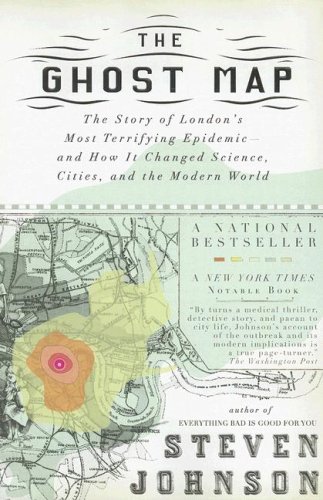
From the Library: "The Ghost Map," engaged amateurism, and a chat with Steven Johnson

Unless you are a hardcore lit nerd, it’s hard to imagine that a book about Victorian London would be an evocative and exceptionally fantastic read.

It’s even harder to believe that such a book would be wholly relevant to the plights of modern civilization, and yet that is exactly what Steven Johnson’s haunting historical narrative The Ghost Map is. From his cell phone in a cafe in Brooklyn recently, the best-selling author of the polemical Everything Bad is Good For You and the recently released The Invention of Air asserted that The Ghost Map is “not just a book about history,” but “a book about why this particular point in history is incredibly relevant for a number of reasons.”

That point in history is the horrifying cholera outbreak on Broad Street in London’s SoHo district in 1854 that ultimately claimed hundreds of lives in less than two weeks. Told in chapters named for each day that the epidemic ravished the neighborhood, Johnson follows the path of Dr. John Snow, an amateur epidemiologist who has a theory that the spread of the disease is somehow related to the water pump in the center of the district. Though it does so understatedly, The Ghost Map turns out to be a strong case against mass-market consumerism while drawing attention to “engaged amateurism,” as Johnson writes, and the underlying heroism and undervalued advantages of knowing one’s neighbor.

Both highly readable and wonderfully conceived, The Ghost Map, then, is a resounding and noteworthy lesson in perspective and the interconnectivity of everything, from microbes to city infrastructure. Not unlike Everything Bad, The Ghost Map utilizes what Johnson calls a “long-zoom approach,” backing up far enough to have a bird’s-eye view of patterns of life and death. “One of my favorite parts of the book was attempting to figure out why the miasmatic theory [that cholera and other diseases were transmitted through the air and not the water, as we know today they are] stayed around as long as it did.” Johnson’s speculation on this point is one of the book’s most venerable aspects. Tying together parallel facets of bacterial and human evolution, microbial and urban consciousness, as well as medical and political history, Johnson compels his readers to undertake a collective self-assessment of the way they live now.

Asked why he took on the topic of Victorian disease, Johnson said, “The history of bad ideas is especially important to teach. Every age in the history of humankind has had an enormous blind spot that they don’t know about. A hundred years later, though, we can look back and see our mistakes.” Answers and revelations about these errors often come from those who “think across many fields of study at once,” Johnson said. Success, it seems, is the result of working on different levels simultaneously.

The Ghost Map closes with musings on the future of humans, cities, and diseases that love nothing more than densely populated areas. And though the epilogue, with its ruminations on the next one hundred years, is truly terrifying, it doesn’t lack a dose of optimism. The book’s last line is, “So let’s get on with it,” a simple declaration that works to capture Johnson’s confidence that the human race can do monumental amounts (both individually and communally) to change our world, but only when it finally chooses to do so. And the local dedicated novice—the heroic figure at the center of The Ghost Map—it turns out, might just be our greatest weapon against disease, terrorism, and global warming.

Friday, April 10, 2009

From the Library: "Five Skies," along with some thoughts by author Ron Carlson

There are certain books you read that once you’re finished you can’t believe you ever existed having not vicariously lived through the experience on which the book hinges. This feeling is often accompanied by an introduction to an author you can’t believe you didn’t know had been writing all these years while you read one mediocre memoir and unaffecting novel after another. It’s like meeting someone out of the blue one day and somehow having an intensely immediate bond after only a few bits of conversation in a bar or cafe.

But this, in fact, is exactly what happens with Ron Carlson’s most recent novel Five Skies. Radically simple, the novel involves three men who are hired and descend on a barren expanse of Idaho to build an enormous ramp that will be used in a daredevil stunt. Not knowing one another beforehand, the men work day in and day out as summer blooms and their own troubled pasts come to light. As anyone who has been there knows full well, there are hardly any hiding places on the grassy Western plains and accordingly, Darwin Gallegos, Arthur Key, and Ronnie Panelli find little to do there but work and think, think and work. And work, it turns out, is what Carlson himself believes the book is fundamentally about. Via telephone, Carlson told PDXWD he thought Five Skies showcased “people solving their problems by using [their] bodies to combat abstraction.”

When we asked Carlson if there were any overt influences on his creating Five Skies, the author said that his writing it “paralleled the way the men in the novel build the ramp—step by step, over many years.” Five Skies, in fact, is only the second novel Carlson has published in the last 25 years. “I kept interrupting it with other work,” Carlson said, unaware, it seems, of the irony of his statement. “My father was an engineer, a brilliant and very careful person. We talked a lot about that, using oneself to make something happen, to achieve something.”

Carlson, who teaches at the University of California at Irvine and who has written four collections of short stories and three other novels, considers the various distinctions his novel has garnered “pure gravy.” His sentiment, like many of the phrases and scenes that make up Five Skies, seems not only completely honest, but also perfectly descriptive, one of the author’s and the novel’s greatest attributes.

All told, Five Skies may end up reminding readers of Hemingway’s novella The Old Man and the Sea, especially in the sense that the characters are all forced to confront their mortality as each participates in, as Carlson’s character Gallegos puts it, an argument with God. “There’s a dichotomy of having a heart, but also having skin and a body—that outer/inner struggle,” Carlson said. “I wanted to write a book that dealt with that dichotomy because I distrust the easy generalization. I don’t know that we learn anything by the easy epiphany or the visceral realization. Decisions are complicated and messy.”

The novel is certainly not all flowers and gems of self-realization, however, like a lesser book would be. Even more thoroughly, if subconsciously, linking himself with Hemingway, when asked if there was any one thing he really hoped readers would take from Five Skies, Carlson said, “A simple story that’s as true as possible. That’s what I want them to get and take, because a day’s writing is something I can stand on.”

Tuesday, February 24, 2009

From the Library: "November 22, 1963" by Adam Braver, with additional author interview


November 22, 1963
: A Novel
Adam Braver
Tin House, 206 pages

Much like you, I remember exactly what I was doing September 11, 2001. I can repeat conversations I had in those first minutes after planes slammed into the towers and can recall sitting motionless that afternoon listening to the radio. Something ineffably enormous had just happened to me, though I was some 2000 miles from Manhattan.

Things could never return to how they were before and hence, this moment was truer and more real than all others simply because of how unreal it was.

The poetic horror of this paradox is the very issue behind November 22, 1963, an unsettling new novel by Adam Braver, published by Portland's Tin House Books.

As you have undoubtedly guessed, 11/22/63 recreates that historic day JFK was assassinated. Combining disturbing facts with delicate fiction, Braver succeeds from that foundation in building a beautiful contemplation of collective and personal trauma. In a way, then, the book is not unlike the investigation we have all come to know by heart. And yet the novel, told as is it through a mélange of different perspectives (from Jackie O, who refuses to change her blood-stained dress, to a motorcycle policeman on whom blood and brain splatter, to the man who almost didn’t catch the whole awful episode on film) really becomes more about shock and suffering than anything else.

The successes of 11/22/63 lie in Braver’s ability to gently and respectfully reside, like a professional surgeon might, in the stomachs and minds of the people who lived through that day. The sourness of nausea; the dizziness of nerves; the anger at the continuation of time; the limp paralysis of dread: these are the facts that Braver offers up.

Halfway through 11/22/63, you realize the novel is somehow not about JFK at all, but about us. A lesser writer would have failed at piecing this story together in such a way that we are okay reliving that monumentally awful day, but in Braver’s hands, we come back to the present wiser versions of ourselves, if also a bit sadder.

Q & A with Adam Braver

PDXWD: Was there ever a moment in which you felt somewhat irreverent having “fictionalized” one of the nation’s most tragic episodes?

Adam Braver: I never had a feeling of irreverence, in part because I was trying to be honest to the events and the people. Oddly enough, some of the seemingly most irreverent parts of the book are the most factual—such as the transcripts of the conversations between LBJ and Jackie Kennedy.

PDXWD: Was there specific criteria you used to decide how and with which pieces of information to take creative liberty?

Adam Braver: The most creative liberty was taken with the pieces where I had the least amount of information, like with Jackie Kennedy, where there is so little available insight into her mind in general, especially on the flight back from Dallas. My goal was to strip away the larger-than-life aspects and see her as a human being who is suffering real human emotions following the sudden loss of her husband. Of course in my portrayal, the public is always on the verge of interfering with the private, but I wanted to see a woman who was in a sense having her last private moment with her husband and the tragedy before both forever became owned by the public.

PDXWD: To what extent do you think that personal and communal catastrophe is always somehow immediately mythical?

Adam Braver: I agree for the most part. Certainly television had a big part of this instant nostalgia and mythology, as everybody could experience it in real time, with a collective reaction—and, equally important, all getting the same interpretations, images, etc. But that is what really drove the book for me. My intrigue was in the equation fact + memory + story = history and how often that combination is the beginning of mythology, depending on what people do with it.

Monday, February 23, 2009

Nine Questions for Justin Vernon about the woods, Bon Iver, and For Emma, Forever Ago

1. You have said that before moving to the cabin something “had gone wrong” with you and you were “on a path to nowhere.” So you left. You packed up and headed deep into the woods where you lived alone and, albeit unintentionally, made a beautiful album, For Emma, Forever Ago. Now that you’re back and touring as Bon Iver and being featured on TV and even putting out a new EP, how has it gone reconnecting with society after your time alone with no one and nothing but your thoughts?

2. What do you now care less about?

3. You have also been quoted as saying, “If you drown yourself long enough, you realize you are just running from some truth.” What truth was it that you confronted as you chopped wood?

4. Since you have mentioned that the song “Skinny Love” is, in a sense, directed at yourself, some lines such as, “Cut out all the ropes and let me fall,” “I told you to be patient / I told you to be kind,” as well as “Who will fight?” remind me of a scene in David Fincher’s film version of Fight Club in which Brad Pitt’s character burns Edward Norton’s character’s hand with lye. The point of this scene is that not until you hit rock bottom and lose everything will you ever truly be free, and only we can get ourselves to that point. Are you free?

5. Your album has a reverberant, plangent component to it, as if it was recorded in a cathedral or a canopied forest somewhere; that is, your voice floats around and echoes within the songs, giving the entire work a spiritual quality. I guess this really isn’t a question.

6. I find myself putting on For Emma, Forever Ago when it is cloudy and cold and rainy and really sort of depressing, especially when I want to be kicked in the ass to get going on being who I want to be. What do you think of this?

7. I have watched the several intimate performances you gave that were filmed by Vincent Moon and posted on La Blogotheque. You should do more things like that, don’t you think?

8. Do you want to have a pipe and talk about the recession? I would like that.

9. In the end, I keep coming back to the image and idea of you in the cabin: totally alone (except for the animals); hunting your own food; capturing your own heat; sleeping through the harsh winter nights; and then being prompted by something primordial inside of you to make this album, as if you had no choice. “It wasn’t planned,” you say. “The goal was to hibernate.” I mean, you really did it; you left everything behind and survived on your own for months in the woods. That’s an amazing feat in itself, and a gorgeous new album happened into existence, to boot. Why don’t more people do this?