Showing posts with label from the library. Show all posts

Tuesday, June 9, 2009

From the Library: Getting Out of "Into the Wild": Tracking Christopher McCandless, from article to book to film to DVD

Late in 2007, Sean Penn’s film Into the Wild stirred renewed interest in the story of Christopher J. McCandless, the young man on whom the film, and Jon Krakauer’s book of the same name, focuses. It’s been over fifteen years since the young man walked out of civilization and into the wild, and the story of what happened to him remains in the public consciousness. But the three depictions of him--the original 1993 magazine article by Krakauer, the resultant book (1996), and then the film--are fundamentally different.

A graduate of Emory, McCandless tramped across the nation for the better part of two years before thumbing his way to Alaska to embark on a solo, natural “odyssey” of his own devising. If you’ve never heard of him, the facts are these: McCandless hunted and gathered in the solitude of the Last Frontier for more than a hundred days, but eventually starved to death at the age of 24, and lay dead in an abandoned bus in the Alaskan bush. Moose hunters found his body in September 1992.

This PDXWD writer came to McCandless unchronologically, seeing the film first, then reading the article, and finally the book—a circuitous route, true to McCandless’ style. The question that remained after all this exposure to the story, however, was: What are we supposed to make of Chris McCandless and the wide range of responses—from anger to understanding—his adventures have incited from readers and viewers?

One of the main problems in discussing McCandless is that we are apt to interpret his actions before we know much about him, a situation that makes it difficult to describe what he did without using such words as “sad,” “tragic,” “unwise” or even, as some people do, “stupid.” Both Penn's movie and Krakauer's book make compelling interpretations of McCandless’s ill-fated sojourn (though perhaps McCandless wouldn’t have called it “ill-fated” at all), but they also succumb, inevitably, to the very impulses they warn readers against: Krakauer and Penn cannot help but want you to agree with their visions of McCandless.

The film, for instance, features carefully-timed Eddie Vedder tunes that jibe with McCandless’ letters being written over the action. I wished many times that more trust were put in cinematography and the story itself, rather than elaborately-planned pathos--the film lacks important silences and is worse because of it. Penn’s adaptation shines a sympathetic, if not overtly heroic, light on McCandless and his trip, romanticizing the man's hopes and dreams. Penn presents an homage to the man, but the McCandless character is rarely allowed to just exist onscreen, because McCandless the man is forever refracted through Penn’s vision of him.

As a book, Into the Wild is vigilant in continually paying respect to McCandless, never allowing the young man to be boiled down completely. Krakauer does not hide that the impetus behind turning “Death of an Innocent” into a book was in part to rescue McCandless from those who called him dumb and ill-equipped after the article first appeared. (Many Alaskans lambasted the magazine for publishing a piece that would encourage more "crazies" to trek to and through their state.)

Rather than convince us of McCandless’s bravery with catchy guitar riffs or extended comparisons to visionaries of the past, however, the film and book might have allowed us to decide on our own whether what McCandless did was courageous, ludicrous, or both. Though those second and third options are certainly plausible, the overwhelming evidence the film and book present is that McCandless rests safely in sainthood. Both seem to imply that they don’t want McCandless maliciously interpreted, though to graciously interpret him is okay.

First published in Outside in 1993, Krakauer's “Death of an Innocent” (the original article that he expanded to create the longer, more robust Into the Wild) was a finalist for a National Magazine Award, and is still available in Outside’s online archive. McCandless’ actions and inspirations were too complex and unconventional to be reduced to something simple, and lost in the film and book are the raw, uninterpreted facts of the original article’s reporting, and its unprocessed details that allow the reader to make of the situation what she or he will.

For me, therefore, these facts themselves—left alone, as they are in the magazine article, without elaboration or lengthy explanation—are the most compelling, because it seems that's what McCandless himself would have wanted. Indeed, the young man desired only to live as fully as possible without the burdens and layers of meaning and symbolism and interpretation heaped on him or what he did.

Monday, June 1, 2009

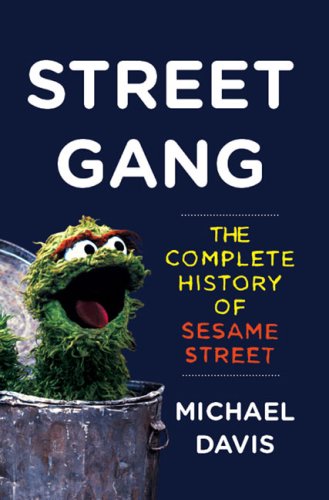
From the Library: Michael Davis's "Street Gang: The Complete History of Sesame Street," and thoughts on the dreams of the 70s in the era of Obama

One of this reviewer's earliest television memories is watching the upbeat intro to Sesame Street in a state of rapt attention. In the version I remember (aired in the early 1980s), Big Bird and pals run up and over a park hill and through the city as they ask in song, “Can you tell me how to get, how to get to Sesame Street?” And though I didn’t realize it until looking at Street Gang, Michael Davis's newly-released history of Sesame Street, a lot of what I learned about people, math, spelling, and society came from that show. But of all things on which to write a history right now, why Sesame Street?

“The show turns 40 on November 10th, for one,” Davis said via telephone with PDXWD recently, “but more importantly because the history of Sesame Street is the history of our culture. So many of the stages of children’s development are mirrored in the show, and I wanted to do a serious book about something we all know and all enjoy, giving people an opportunity to explore something they see every day, but never give much thought to.” Modeled loosely on the book Sea Biscuit, which Davis deeply admires, Street Gang tells the story of a pop-culture behemoth, letting readers in on the story of its development.

To read about Sesame Street is to notice that our society has experienced, as Davis puts it, “breathtaking change,” and that “the way we respond to each other is so very different than it was.” Sesame Street was one of the first shows in history to mandate that there be an integrated cast. African Americans, disabled Americans, and Latinos were all strong characters woven into the show’s fabric, even if the writers never drew much attention to the fact that it was teaching anything about diversity. Davis claims that exposing children to such diversity in the preschool years has a remarkable impact on the tolerance they extend as adults. “In fact,” Davis said, “I firmly believe that the progressive ideals of Sesame Street ushered in the era of Obama. It was a dream in the 1960s and 1970s that we could live in an integrated society, even if it really wasn’t like that then.”

And even though millions of its viewers have aged out of watching the show, Sesame Street continues to stay current. As Davis explained, Sesame Street has its own YouTube channel, and constantly takes on sensitive issues, such as a parent returning from Iraq disfigured. “The secret of Sesame Street’s success,” he said, “is they've never sat still for even a moment. They're continually asking what’s in the modern zeitgeist? What do children need now?”

As much as we may forget them in our daily adult lives, Oscar, Big Bird, the Count, Cookie Monster, Bert, and Ernie are by now part of our subconscious. “We hold these characters very dear to our hearts,” Davis said, “and they are so embedded in our culture that we want to share them.”

And Street Gang is a gorgeous and intelligent book that follows the creation and evolution of one of our nation’s most important shows. Because “Can you tell me how to get to Sesame Street?” has served, for decades now, as only a rhetorical question. The vast majority of us already know the way.

Wednesday, May 27, 2009

From the Library: Monica Seles's "Getting A Grip," and some thoughts on Hall of Fame induction and autobiography

Peripherally watching the NBA play­offs this year, PDXWD has often thought about Michael Jordan and Larry Bird, now retired and relegated to the sideline (read: couch), from where they are forced to watch Kobe Bryant and LeBron James, their on-court successors and the league's two brightest stars. What must it be like, we wonder, for once-infalli­ble athletes, now barely into middle age but ousted, to have to watch a new generation take over the sport they once dominated?

Contemplating your own athletic obsolescence is hardly an enviable situ­ation, megastar or not. Add in early and unmatched success, an ongoing and debilitating battle with food, a freak and psycho­logically-paralyzing occur­rence, and an attempted comeback, and you have a glimpse of the story Monica Seles tells in her new book, Getting A Grip: On My Mind, My Body, My Self.

Tennis prodigy of the 1990s, Seles won the French Open at 16 (the youngest champ ever), and has now, some 20 years later, written this autobiography to coincide with her induction into the International Tennis Hall of Fame this summer.
That honor is complicated, of course, by the fact that in 1993, when Seles was at the top of the ranks, a deranged fan stabbed her in the back during a match in Germany. After the bizarre incident, Seles was out for two years, and never recovered enough emotionally to contend again. (And the assailant never served jail time.) “It’s a horri­ble thing that happened in my life,” Seles writes in the book, “and it irrevo­cably changed the course of my career and inflicted serious damage to my psy­che. A split second of horror fundamen­tally changed me as a person.”

Still, Seles said in an email recently to PDXWD, “as a girl growing up in the for­mer-Yugoslavia I never imagined I would be inducted into the Tennis Hall of Fame. It is a dream come true. Know­ing that I will be a Hall of Famer is a great honor and a great way to celebrate my tennis career.” Asked if she studied any other athletes’ books or autobiographies before writ­ing her own, Seles professed to having read athletes’ and non-athletes’ alike, including the work of Howard Hughes, Coco Chanel, Dara Torres, and Julie Krone. An autobiography of her own, she explained in her email, would help “spread the message to people out there who were struggling with their weight, like I did for nine years, and take con­trol of it and win that battle in life.”

Last year, Seles agreed to appear on the sixth season of ABC’s “Dancing with the Stars,” an episode she details in her book. She was the first female celebrity contestant eliminated. “While staying out of the public eye" since offi­cially retiring, she writes, "I’d been able to rebuild and fortify my core and I decided to put it to the ultimate test: ballroom dancing in front of millions of people. If I was going to test my newfound inner strength, what better way to do it than by risking total and complete public humiliation on reality television?” True enough.

After following Seles through these travails outlined in Getting A Grip, you begin to gain a fuller if sadder understanding of the pressures society puts on professional ath­letes, a fragile situation indeed considering the heaps of pres­sure athletes already load upon them­selves. “Who was I without tennis?” Seles asks about halfway through her book, and the question reverberates because the answer is so simple: just a normal person. Unlike you and me, though, Seles — along with the Jor­dans and Birds of our world (and the Roman gladiators before them) — had to age, compete, struggle, and remake herself in front of a passionate audience that was always watching.

Sunday, May 24, 2009

From the Library: The Last of Kevin Wilson's "Tunneling to the Center of the Earth"

“The Choir Director Affair (The Baby’s Teeth)”
Two stories in the same collection written in the second person! This could be a record and entirely out of control. A little disappointing, however, is the fact that “The Choir Director Affair” is not as tidy and interlooping as the previous second-person foray, but it feels more heartfelt, at least. In this story, our narrator is friendly with a married couple whose baby is born with a mouthful of teeth, teeth that are beautiful and perfect, but the sort of teeth that make “you feel like a real son of bitch” when you see them for the first time, because “why wouldn’t someone have mentioned this beforehand? A small warning: this baby will smile and it will startle you.” The real movement of this narrative, though (in line with the second paragraph’s promise, “The story isn’t about the baby anyway, but the father of the baby”), is in the repetitive and awful behaviors in which adult people find themselves eddying. The mother and father, like so many of us, “are arguing,” the story says, “but quietly, under the surface. Too much sugar in one’s coffee, newspaper folded and refolded in the face of questions, mentions of after-school activities.” This is terrible to read because it is so spot-on and reminds you of your ex. And so it happens that the father has an affair, lies about his whereabouts, leaves the child often in the narrator’s care when he romps with this other woman, and then eventually leaves the mother and destroys a little family. He goes to Austria, has wild times, enjoys this other woman fully, but is inevitably left by her. Do mother and father then get back together in a storm of forgiveness and kisses and sex, though? Of course they do. And does the child age into an awkward normal-toothed teenager? Of course he does. Why? Because “the things we once loved do not change,” the story ends, “only our belief in them.”

“Go, Fight, Win”
Hot damn, this story is solid, even if the first half of it reads almost exactly like the relationship between Jane and Ricky Fitz in American Beauty (replicated in eerie and precise detail, we might add). Besides this bit of deja vu, though, the unfolding of a strange and touching relationship between a 16-year-old reluctant cheerleader and her 12-year-old neighbor boy is well-crafted and subtle, eliciting many fine comparisons to the shorter work of Salinger and Eggers. Of special enjoyment is the care with which the girl in the story works on model cars at her desk at night; it provides not only the image on the book's cover, but resonates as a metaphor for beginning to piece together in our early years what we should expect out of life, and what it expects of us.

"The Museum of Whatnot"
This reviewer will be so bold as to call this the best story in the collection. A bold move, per se, because it is probably the most straightforward and classic of the bunch--without much trickery or literary bells and whistles--but also because it is the most nuanced. Had we the space, we would offer a Marxist reading of the protagonist's desire to rid herself of her possessions, and tack on another even closer reading of her job: a curator for a, you guessed it, museum of whatnot. But since we are not afforded with the desire at present to flesh out such readings, let it suffice to say that what happens, in not so many words, is the female lead curates and curates and curates (choosing and sorting and displaying everything from garbage bags of rubber bands to millions of paperclips), until she concedes it's okay to own some things once in a while. In addition, spurred by the advances of a doctor fellow who frequents the whatnots, our protagonist slowly discovers that the lonely life she has been leading has been a conscious decision all along.

"Worst Case Scenario"
It is unfortunate that Tunneling to the Center of the Earth ends with this story, not because it isn't good, but because it's just not as good or as polished as the rest. Wilson has said the impetus for this story "came from illogical fear and loneliness, which is where a good many of my story ideas come from," which is a compelling and fruitful place to be working from as a writer, but only if you allow your characters to explore these feelings wholly, and without encumbering them with weird stipulations. In "Worst Case Scenario," for example, the main character's own psychoses are the thrust of what we care about him resolving, and yet Wilson weighs the narrative down by giving the character a crazy job (collecting and reporting on worst case scenarios), when really the worst case scenario is the character's life itself. There is nice resolution to the story, but by then, we just sort of wish we had reread "Museum of Whatnot" instead.

Thursday, May 21, 2009

From the Library: The second third of Kevin Wilson's "Tunneling to the Center of the Earth"

“Birds in the House”
This story is the strongest and most intriguing yet in the collection, due to the conflict in which it is rooted (Southern-style inter-familial loathing) and the likable protagonist Wilson has chosen to narrate it (a hopeful young boy). The premise goes: a old woman passes away and leaves her house to one of her three adult sons who have feuded long and hard. The catch: to determine which son gets it, they must compete in a contest that involves each of them folding 250 paper cranes and placing them on a table surrounded by fans on its four corners. The winner: whoever made the last bird on the table after the fans are turned on. Like its companions, “Birds” is full of excellent imagery (“The walls are soft from rot and feel like sponge against my fingers” and “Finally my father gave up, went into the house for the Colt .45, and put a bullet between the eyes of every cow still standing until he stood in a cloud of red-tinged dust,” and “The birds are flying, if only for a brief moment, and I watch a rainbow of cranes fly around the room, dip and loop and dive in the air”), though the fighting between the brothers is stereotypical in places. Overall, however, this story is the shit.

“Mortal Kombat”
This is your common teenage-boy-sex-story with a little twist and an alluring conceit. Scotty and Wynn are nerdy best friends whose “sole extracurricular activity involves traveling all over the state and competing against other very unpopular teenagers, answering random academic questions.” In short, “they do not fit into the spaces available to them.” What starts as a brief kiss between the two boys one lonely afternoon folds out into a story about each of them discovering what sexuality means to their bodies, their identities, their psyches, and moreover, their friendship. When the boys, who have each purchased a copy of that 1990s megahit videogame "Mortal Kombat" and have practiced it alone for days on end, finally sit down to play against one another, the game, as games often do, takes on significantly more meaning than what occurs onscreen.

“Tunneling to the Center of the Earth”
Goodness, this is a strange but moving story. Wilson has a penchant for splicing together the plausible with the totally implausible, caring not to distinguish or draw attention to either more than the other, and so we’re left in “Tunneling” with three recent college graduates who decide to dig a very, very deep hole in the backyard, from which they begin building a network of tunnels underneath the city. This is their life: they dig, they eat, they sleep, entirely lost and uninterested in the goings-on above ground. What an apt metaphor for post-college life and early adulthood, no? “Tunneling” is fresh and applicable (for many of us, at least) in its depiction of having to join the real world after being mired for years in useless academic abstraction.

“The Shooting Man”
This story launches and never comes back. It’s like a boomerang you throw that doesn’t adhere to the trajectory it promises and sails straight off into the distance, landing some many, many frustrating yards away. Then what happens is you don’t want to go get it because the game has been ruined; the boomerang has not behaved. Wilson admits in the interviews at the back of the book that he tried to “turn the story into something more akin to pulp, like the 1950’s horror and mystery comic books [he’d] read in high school,” and as such, he technically succeeds. So as not to fully give away the story, though, we’ll just say that the narrative hinges on a particularly disturbing circus show that no one in town can stop thinking or talking about: Maximilian Bullet, the man capable of shooting himself in the face. How does he do it night after night? everyone wonders. We’ll give you one guess.

Wednesday, May 20, 2009

From the Library: "Lonesome Dove" by Larry McMurtry, including bonus thoughts on Sir Walter Scott's "Ivanhoe"!


Dear Portland Writer,

Have you read Ivanhoe? It is awesome: engaging, emotional, chilling, thrilling, and some people will even admit it's good literature. Larry McMurtry, for example, obviously thought Ivanhoe was awesome, because he wrote Lonesome Dove in homage to it (we hypothesize).

Both novels begin with pigs. Ivanhoe (1819), after a few pages of history and pastoral description, starts like this:

"'The curse of St. Withold upon these infernal porkers,' said the swine-herd, after blowing his horn obstreperously, to collect together the scattered herd of swine, which, answering his call with notes equally melodious, made, however, no haste to remove themselves from the luxurious banquet of beech-mast and acorns on which they had fattened, or to forsake the marshy banks of the rivulet, where several of them, half plunged in mud, lay stretched at their ease, altogether regardless of the voice of their keeper."

And then Lonesome Dove (1985) starts like this:

"When Augustus came out on the porch the blue pigs were eating a rattlesnake--not a very big one. It had probably just been crawling around looking for shade when it ran into the pigs. They were having a fine tug-of-war with it, and its rattling days were over. The sow had it by the neck, and the shoat had the tail. 'You pigs git,' Augustus said, kicking the shoat."

Aren't those great pig-based beginnings? We didn't notice the similarities at first, but partway into Lonesome Dove the vibe suddenly seemed familiar: the books run at the same speed, with the same peaks and troughs. Then the evidence started piling up. Both have two or three main characters and six or seven vivid supporting characters important enough to get several chapters of their own. Most of the characters in both novels are intelligent and likeable, except for the villains, who are unforgettable and terrifying. The story goes along one thing after another for awhile and we stay absolutely involved, and then the action erupts and we grow actually breathless with excitement. In both novels, everything that occurs is either deeply satisfying, or deeply frustrating but in a literarily-satisfying way. In both novels, the ends of many chapters read like the ends of the best novels we know. We vow to hold all fiction to this standard forevermore, and know we cannot keep the vow and go on being avid readers.

So we had formed this hypothesis, about how Larry McMurtry loves Sir Walter Scott, and we're reading along and we're reading along, and then on page 651 of Lonesome Dove one of the characters is reading Ivanhoe (imagined pictorially at left) to her kids, and we're like, "Aha! We knew it!"

In closing: check out these books. They are terrific. If you like one, you will like the other. If you like awesomeness, you will like both.

Your pal,
PDX Writer Daily

Saturday, May 16, 2009

From the Library: "Tunneling to the Center of the Earth" by Kevin Wilson

What an excellent epigraph Kevin Wilson has chosen to open his debut collection of stories, Tunneling to the Center of the Earth: “There is nothing in this warm, vegetal dusk / That is not beautiful or that will last.” Lovely, just lovely.

“Grand Stand-In”
Like the strange workplace stories of George Saunders that Kevin Wilson says inspired this piece, “Grand Stand-In” details the last few weeks of a woman in the business of “standing in” as a grandmother. In other words, the narrator is a grandmother for hire, which is a compelling idea initially, but one that the story too forcefully attempts to make real. The terminology and explanations of the narrator’s job are stiff and roughly-stitched, as if the occupation Wilson has created has been grafted too hastily onto our actual economic marketplace. Obviously, the story is not supposed to be a comfort (as it deals with confronting one’s own replaceability and inevitable death), but the loads of business jargon unnecessarily hyperbolize and thereby cloud the emotions the story sets out to explore, which is unfortunate. And though the narrator is likable enough as she comes to terms with her job and her life, there are a few scenes in which the narrative falters because she is just too aggressive to be believable.

“Blowing Up On The Spot”
Unlike “Grand Stand-In,” this story succeeds in its peculiarity because it does not make any apologies for its being so curious. It is about a young man who works at the Scrabble tile sorting factory looking for Q's, and whose parents spontaneously combusted on the subway. He lives with his younger suicidal brother and wonders if he, too, will blow up one day unannounced and, as entertainment, counts his steps everywhere he goes.

The legs of this story are the very many superb passages spliced into its short span. Take this description of the narrator’s girlfriend, for example: “Joan emerges from the kitchen carrying a tray of chocolate turtles. Joan’s hair is shiny black and falls pasts her shoulders. Her eyes gleam brown like caramel and when she catches my gaze, her smile creeps across her face in small increments, as if her happiness starts in one place and slowly moves out in all directions. She holds up one of the chocolate turtles and lets me take a bite. Pecans, chocolate, and caramel mix together in my mouth and I taste Joan’s fingertips on my tongue.” That is really nice, and sexy. Or, take the brother’s second suicide attempt: “Caleb has tried to kill himself twice in the three years since our parents died. The last time, he slit his wrists with a Swiss Army knife during practice and dove in the pool to swim a hundred-meter freestyle, trailing a cloud of blood behind him.”

There are more like this throughout the story, but you should come across them yourself, like happily stumbling into a meadow. When things are written this well, we more easily forgive and begin to enjoy any absurdness. The story ends up coming together like a tiny and beautiful painting of an impossibly strange animal, sort of like some exquisitely-rendered owl with a rack of antlers and oversized cougar paws.

“The Dead Sister Handbook: A Guide For Sensitive Boys, Volume Five (Laconic Method to Near Misses)”
[Full disclosure: this tentacle of PDXWD loves almost everything written in or using the second-person “you.” We even wrote a degree-earning piece of writing on the use of the second-person “you” and are without fail attracted to stories that are written fully, or almost entirely, in this way.]

This story is written in the second person and it is excellent. Composed of paragraphs that are supposed entries in a handbook for sensitive boys concerning the death of their sisters, it does little in the way of adhering to narrative structure or achieving linear progress--structure and progress within the piece occur through parenthetical references to other entries in the handbook itself, which unfolds as a gorgeous interlacing of anecdotes, warnings, and remembrances. Here is a sample entry, “Look Alikes”: “Sensitive boys will encounter between four and eleven women who resemble the dead sister. Do not, under any circumstances, attempt to talk to these women, follow them down crowded city streets, or pay them money in exchange for sexual favors. Nothing good can come from this.” This is just brilliant and you know you like this. You should read more stories like this one.

More to come...from the park benches of New York City.

Wednesday, May 13, 2009

From the Library: Ursula K. Le Guin's "Direction of the Road" considered alongside Paul Shambroom's "Picturing Power"

Direction of the Road, by Ursula K. Le Guin, with original woodcut by Aaron Johnson, Foolscap Press: Santa Cruz, 2007; # 20 / 150, as held in the Special Collections Archive at the Multnomah County Library's Central Wilson Room.

Power is often a matter of perspective. "Powerful" people are usually those who perceive themselves to be such, and accomplish tasks and jobs with the belief that they are who they think they are. "Powerlessness," likewise, can be understood as perceiving oneself to be either in want of what one doesn’t have, or unable to procure that which others are already enjoying. Both situations—powerfulness and powerlessness—are contingent on a certain perspective.

But what if that perspective changes? What happens when people don’t want or don’t perceive themselves capable of handling the power they have been given? Two recent publications present conceptually different examinations of this interplay between authority and viewpoint.

Ursula K. Le Guin’s short story "Direction of the Road," originally published in the mid-1970s, has been given new life of late by Foolscap Press in a special limited edition book released in 2007. Pressed on linen wrapper paper made by La Papeterie Saint-Armand in Montreal, Foolscap’s edition comes in a portfolio box covered in Japanese cloth, and includes an original anamorphic woodcut by Aaron Johnson. The sum of this fine craftsmanship is a rare and slim volume that is itself an experience in perspective, corporeality, and power.

As the inside cover explains, anamorphic art, whose origins date as far back as Leonardo da Vinci, has enjoyed a long history in which artists have experimented with "perspective and other 'anamorphic projections'," while "challenging the viewer’s usual conventions of looking." The book's introduction suggests that "Aaron Johnson’s woodcut continues this exploration and achieves two things at once: his art casts the viewer into an active role in relation to the art and, more important for this story, it allows the image freedom of movement," which is most certainly true and alluring from the get-go.

The result is a stunning reading experience. Direction of the Road is told from the perspective of a large oak tree that believes its duty is to grow and shrink as people come and go in relation to it. It would be an understatement to say the tree “believes” in the role it serves, since the tree never vacillates in this conviction; it exists simply to grow and shrink as people come closer to it or recede from it. The tree strictly adheres to this place and purpose in the universe, a position it believes is secure.

Enter Johnson’s woodcut. Inside the large rectangular folded portfolio in which the story is bound, there is fastened a cylindrical mirror that the reader is instructed to place on end next to a semicircular, warped-seeming woodcut. Once the mirror is in place, it magically reflects the woodcut image as a crisp illustration of a large tree and a person sitting beneath it, while two birds fly past overhead. But the reflected woodcut also has another important characteristic: the reader can, by moving closer to and farther away from the mirror, experience the tree growing and shrinking in size, just as it behaves in the story.

The narrative doesn’t last long, but in its few pages, decade after decade pass atop a small hill from where the tree watches humanity progress, all the while remaining diligent in its duty of getting bigger as people approach and smaller as they retreat, never failing, as the story’s original 1974 introduction states, “to uphold Relativity with dignity and the skill of long practice.” Though it hardly needs upkeeping or modernization—since the story seems naturally timeless—Le Guin updated the introduction for this release, adding that if the tree that inspired Direction of the Road still stands on its Oregon hillside, “it is coping after the single outburst of anguish [that is recorded in the story] grandly and without complaint.”

That singular eruption to which Le Guin alludes is the crux of the story: one day, a car runs off the road and strikes the tree head-on, killing the driver. After this event, the tree objects to the power with which it has been imbued: to crush people unintentionally. Since the driver only really sees the tree for the first time when looking up at the last moment before striking its trunk—all these years, the tree was there, but was a mere afterthought for the driver, a part of the landscape that went unnoticed—the tree declares that “it is unjust to require me to play the part, not of the killer only, but of death.” Since the driver confuses the tree for death itself, the tree gets even angrier, or at least as angry as an old oak can become, and concludes: “For I am not death. I am life: I am mortal. If they wish to see death visibly in the world, that is their business, not mine. I will not act Eternity for them. Let them not turn to the trees for death. If that is what they want to see, let them look into one another’s eyes and see it there.”

The exhibitions catalogued in Paul Shambroom: Picturing Power (Weisman Art Museum: University of Minnesota, 2008) also explore the idea of who has power, what they do with it, and how they look from a particular perspective.

In a sense, Shambroom’s work, like the lens in Le Guin's book, is anamorphic: it forces the viewer to consider his or her own perspective in regard to the image. In many cases, the pictures Shambroom offers are of things 99% of us would never see, or at least not as they are presented here. Shambroom’s subjects include top secret locations (including military bases, nuclear weapons facilities, and security and defense training procedures) and often capture empty spaces: offices devoid of human presence, meetings before they begin, and the insides of factories.

Picturing Power is a gorgeous collection that is capable of making any reader/viewer wonder about who is actually in charge of our cities, our countries, and our world. In addition to over 40 full-color pages of prints, the book includes several insightful essays by notable art critics on Shambroom’s work, and a fascinating interview of Shambroom himself by Stuart Horodner, curator of the Atlanta Contemporary Art Center.

“The intersection of beauty and horror,” Shambroom says in the interview, “adds a tension that’s important to me and to any of the images I make.” It’s the presence of these opposing sensations that places Shambroom’s work in parallel with many historical conceptions of hegemony, since authority is always simultaneously a glorious and dangerous thing to possess. “They are supposed to present people as being heroic,” Shambroom states of his pictures, “but then there’s a series of questions that you start to [have]: this person is here to protect me, but do I really feel safe—safer—knowing that this person is in this gear doing this job?”

Take the image on the book’s cover, “Level A Hazmat Suit, Yellow (‘Disaster City’ National Emergency Response and Rescue Training Center, Texas Engineering and Extension Service [TEEX]),” as one example. In it, a strangely and menacingly outfitted person wields detection devices for, one guesses, identifying lethal substances in the atmosphere, but he stands amidst a bucolic setting, alone, as if seen through a Viewfinder. The response one has to this image is largely connected with the power one senses this person possesses. It’s as if the photo's subject knows and is equipped for a disastrous situation that the viewer, on this side of the image, is in no way prepared to handle. “I do have respect for these people,” Shambroom adds in the interview, “and that has nothing to do with whether I think the policies that they are carrying out are the best policies for our country and for the world…I’m just not sure these activities address the core of the problems we face in the world.”

Stark, usually sparsely populated, many of the photographs capture places without people, or a single person or lonely group that has been granted power, which gives the images a ghostly, dismal feeling. We wonder, much as we do of Le Guin's tree in Direction of the Road, whether these people actually want the power they have been given. “I really don’t set out to provide answers,” Shambroom says.

How do we determine who should be in power? Is it the person or people who know the most? The people who have the most experience? The people with the best ideas and plans? Our own recent Presidential election centered on many of these very queries. In reference to his having taken these pictures, Shambroom claims, “No one else knows how to do it. And I’m not going to let anything stop me because if I don’t do it, it’s not going to happen.” Echoing what the tree utters in Direction, Shambroom seems to wonder whose job it is to make decisions that impact everyone else. Not without his own sense of personal perspective, however, the artist concludes, “It is necessary to my process to have those delusions of grandeur as long as when I come down I realize that’s what they are and I still have to wash the dishes at home.”

Monday, May 11, 2009

From the Library: "Couch" by Benjamin Parzybok


"From ten feet, a guardian angel's view, the view this tale will take, three men carry a couch. An orange, knit couch of considerable size." This statement, appearing on page one, is the last appearance of anything remotely meta or self-referential in Benjamin Parzybok's newish debut novel, Couch.

For the next two hundred and eighty pages, it's pretty straightforward omniscient third person narrative, more or less focalized on one of the book's three main characters. They are the young men carrying the couch. As it turned out, that was fine with PDX Writer Daily, which read it quickly and happily, and felt satisfied by the ending. PDXWD believed—as much as the intricate web-based mash of wires and ponies that is PDXWD can believe anything these days—in the characters, and enjoyed Parzybok's description of Portland's West Side.

Furthermore, PDXWD has already recommended this book to perhaps twenty people. You see, PDXWD has recently accepted a slew of odd jobs to make ends meet. (Those Doctor Bronner labels don't write themselves, people.) So as we were giving War & Peace a little break from us (it just seemed sort of tired, and looking away when we were reading, and generally, just, not present), we read Couch while making change at a very high profile, and thus unnameable, parking structure.

When drivers stopped to pay for parking, we looked up and smiled, and they asked, "Good book?" And we said, "So far, it's pretty great," and handed it to them. And now, through the power of a medium other than the parking structure, we say the same to you: Couch, written by Portlander Ben Parzybok (who won North America's Last Postmodern Manuscript Contest last year) is great so far.

Monday, May 4, 2009

Art as Life, Life as Art: Reviews of Three Documentaries

[The following three documentaries keep coming up in conversation in the places we frequent, so PDXWD thought it best to just get on with writing about them.]

The Cruise, dir. Bennett Miller, 1998

“If I have an essential goal on the cruise right now,” says Timothy "Speed" Levitch in a documentary about his life as a bus tour guide in New York City, “I think that the simplest goal is perhaps to be able to exhibit that I am thrilled to be alive and to be still respected.”

Which is to say that The Cruise is really not about Speed’s life as a bus tour guide in New York City at all. Rather, the film centers on one man who speaks and thinks more precisely and eloquently about cockroaches and parks and desperation than you ever will about Shakespeare or mechanical engineering or memes. Speed, whose nickname most assuredly comes from the rate at which he talks (you may recall his vignette in Waking Life at night on a bridge), spends the entire film constantly navigating away from what he calls the “anti-cruise,” which is obviously everything that stands in the way of "the cruise." Right?

Though it’s difficult to put a finger on what exactly “the cruise” is, since it’s really an urban philosophical treatise more than anything else, Speed puts it this way: “The cruise is about the searchings for everything worthwhile in existence. It is about walking into the bar and lusting after all the worthwhile possibilities of the world. It is about flesh. It is about waves undulating. And it is about exhibitionism…I mean, that’s how I feel about cruising right now.”

With rants about the grid system, disappointing his grandparents, breaking up and getting back together with the city he loves, the myth of the lamed-vavniks and the Baal-Shem-Tov, a babysitter who tried to choke him, the solidity and solidarity of the Brooklyn Bridge, and the sensuality of terra cotta cornices (not to mention amazing recitals of poems, letters, novels, and speeches) The Cruise is nothing less than a whirling, twirling beauty, burning itself at both ends.

If you’re still confused after watching it, though, don’t despair. Simply rest assured that “having an intimate quote unquote love affair with a flower is far more psychotic and riveting than having a love affair quote unquote with some of the banal creatures of the human race, although I’d be into that, too.” So would we, Speed. So would we.

Man on Wire, dir. James Marsh, 2008

Philippe Petit’s ego is about as large as some of the abysses across which he has tightrope-walked, and yet this documentary about his 1974 crossing back and forth between the World Trade Center towers is supremely impressive mainly because it’s so damn unbelievable.

Mixing interviews, archive footage, reenactment, and still photography, Man On Wire is one of those rare films that makes you feel both completely inspired while also paralyzing you as you sulk and wonder what you’ll never do because you’re: 1) too scared; 2) too lazy; 3) too undetermined; or 4) all of the above.

Even if you’ve heard of Petit’s legendary feat before, this film is breathtaking in that it sheds light on the years of planning and reworking and disagreement that went into four men sneaking into the towers (costumed as workmen and businessmen) and stringing the wire between the two buildings in the course of a harrowing sleepless night. And though security measures in such places would probably thwart similar attempts today, the film does a beautiful job capturing this rebellious artistic act that somehow succeeded against all odds.

Petit, in the film’s climax, revels in the stunt for almost an hour on the wire in the crisp foggy morning air of August 7th, all while stunned and smiling onlookers below gawk and exclaim and swoon. The police, though irritated, also seem in awe of the man they arrest, even if they later let go him without pressing charges, citing the artistic quality of his deviance as reason to overlook his trespassing and impersonation and reckless endangerment.

Man On Wire reminds us of today’s street artists like Shepard Fairey (of Andre the Giant/OBEY and Barack Obama/HOPE) and Banksy (the artist who broke into museums to put up his own paintings), guerilla criminals who are beautifying our world one act at a time. Like Petit himself, whose spectacle has been called the greatest art crime of the 20th century, the philosophy “create now, apologize later” seems to live on. And god, if that’s the case, what the hell did you and I do today?

How to Draw a Bunny
, dir. John W. Walter, 2002

Ray Johnson is the most famous artist you’ve never heard of. In fact, let's be honest: even as we were about to begin this review of the documentary we watched and loved that trumpets his life and work from the 1960s through the 1990s, this writer totally forgot his name. And yet despite his slipping from our collective memory relatively often, Ray Johnson was known by and involved with many of the biggest names in Pop Art (Roy Lichtenstein, Andy Warhol, and Christo, to name a few) during his day.

Johnson, however, was one weird son of a bitch. Spending time on tasks and details no one else in their right mind would focus on (or even notice 95% of the time), Johnson constructed elaborate layered collages and paintings, but also involved himself as a performance artist (like hammering a box over and over and over, or throwing pieces of paper into the air and dancing around them, or dropping hotdogs from a helicopter) and considered himself to be the founder of mail art (in which he would send altered newspaper and advertisement clippings to different friends all over the country, calling the experiment the “New York Correspondance [sic] School).” His art was, very simply, his life.

The best aspects of How to Draw a Bunny are the interviews with Johnson’s colleagues who try to grasp him and sum him up for the camera, which is always a futile endeavor. The film is littered with hilariously frustrating stories: his agent recalls how nightmarish it was to represent such a slippery and rambling figure; a gallery owner says Johnson used to call and say he wanted to do a show of nothing, by which he may have meant something, or anything, but also maybe nothing; one of his portrait subjects shares letters from Johnson fraught with complicated and arbitrary price calculations for each artwork in a series.

Considering how integral Johnson figured a participating audience was to and in his work, it’s not surprising that he turned his own life, and death, into an exhibition. The very narrative framework of How to Draw a Bunny, and the concept that stays with you after the film, is the investigation of Johnson’s apparent suicide on January 13, 1995, through which he left us a byzantine, beautiful, and self-contained piece of art.

Wednesday, April 29, 2009

From the Library: "Zoology," painful asymmetry, and a chat with Ben Dolnick

The task of reviewing Ben Dolnick’s debut novel Zoology lays not in deciding whether the book is an enjoyable read (we'll spell it out right here—this is a fresh and excellent portrait of a quizzical young man), but rather in distinguishing it from the vast number of other memoir-novels that have preceded it.

Not unlike the new kid in class, Ben Dolnick suddenly appeared on the literary scene last year. As such, he is a newbie in a prestigious all-boys school of popular pros, the halls of which are packed with the likes of Jonathan Safran Foer, Erlend Loe, Brad Land, Keith Gessen, and Benjamin Kunkel. Black and white photographs of alumni (all-time favorites like J.D. Salinger, as well as recent grads Augusten Burroughs, Rick Moody, Jonathan Franzen, and Dave Eggers) adorn the school’s display cases with books beside the pictures like trophies. (James Frey was expelled.) And so, like having to prove himself on the playground, this tenderfoot twenty-something Brooklynite has quite a challenge set out before him.

Zoology follows a hapless high school grad, Henry Elinsky, who flunks out of college in his freshman year. Floating in and out of the reality of this situation, Henry moves in with his successful brother in New York, where he lands a job at the zoo scooping poop and food pellets. Between meeting a beautiful girl in his building, playing ping-pong with the doorman, realizing that he is a terrible saxophone player, and being yelled at routinely by his boss, Henry finds himself pondering life’s weirdness and lowlights. So far, not much surprise.

If Zolnick sets himself apart, it's in the moments of his narrator’s self-depreciation, sentences that shine like nuggets of originality in an otherwise saturated genre. Asked over email about what he himself reads and on what he models his fiction, Dolnick told PDXWD that he likes books that “present a real-seeming reconstruction of what the actual minute-to-minute, year-to-year experience of being a person is like,” and it’s this facet that makes Zoology successful. “It should be a comfort,” he added in his message, “to read ‘honest-seeming’ accounts of being alive.”

At the heart of the novel, as Dolnick puts it, is the “painful asymmetry” of life’s experiences—that events and regrets and guilt don't align in a zero-sum game. In other words, we can’t fix everything we’ve ever broken, and likewise, Zoology doesn’t try to answer every question it poses. What's striking about Henry is that his reflections are offered without overwrought exertion. At one point late into the novel, for example, Henry muses, “It was hard to imagine now that I’d woken up that morning in a life without Dad’s heart attack in it, that I’d pulled my tuna sandwich out of its bag and had no idea.” Throughout the book Dolnick is honest and real without being gimmicky, and is able to render disappointment in terms that don’t resort to hyperbolized or flaunted self-loathing.

So if Dolnick is aware that he’s in a class of bestselling novelists/memoirists who use their life as fodder for comical and heart-wrenching books, he’s great at not showing it. And though Henry is an obvious nod to Holden Caulfield (both have trustworthy older brothers, lurk in downtown jazz bars, fail often, and attempt to regain composure near the end), Dolnick’s protagonist swears less than Salinger’s, and is far less angry at the world. Treading much the same territory with much the same outcome, Dolnick has produced another young male book on being young and male, but while adding something nice to the pot at the same time.

Thursday, April 23, 2009

From the Library: "God Is Not Great" and a chat with Christopher Hitchens on morals, vanity, and comfort

Christopher Hitchens’ 2007 and most recent book, God Is Not Great: How Reli­gion Poisons Every­thing, is out in paper­back this month, and so PDXWD decided to get in on the action and have a word with Mr. Anti-Christ himself.

The well-known and outspoken British polemic has writ­ten for a variety of pub­lications over the years (from Vanity Fair to The Nation to Slate) and has made a name for himself as a radical thinker on lecture and debate circuits. But while he has taken on a number of
different topics in his career (George Orwell, monarchy, Hen­ry Kissinger, Thomas Paine, Thomas Jefferson, and the Iraq War, just to name a few), God Is Not Great represents an attempt to dive into some essential — and poignant — problems of human nature.

“Morals simply cannot be derived from religion,” Hitchens told PDXWD recently via telephone, “and yet we are condemned to be moral and ethical beings. It is innate in us to consider other people’s feelings.” This fact leaves us, as Hitchens argues in his book’s introduc­tion, in a world where “religion has caused innu­merable people not just to conduct themselves no better than others, but to award themselves permis­sion to behave in ways that would make a brothel­keeper raise an eyebrow.”


So while God Is Not Great features a sensationalized argument, it doesn’t clarify how we might attain Hitchens' proposed “New Enlightenment” once religion is abandoned. The book ends with Hitchens quoting the old Greek adage “know thyself,” but an explanation of how this will help us move past religion and the awful­ness it has caused our world is left to the reader's imagination.

As a result, we wondered if there is any place for religion in Hitchens’ republic. “Keep it in the home,” the author replied. “Religion is a private belief, and it should stay that
way.” And yet home is of course not the only place religion resides, which is the problem Hitchens points out. The rhetorical question he raises at the beginning, and which pervades God Is Not Great, is: “How much vanity must be concealed — not too effectively at that — in order to pretend that one is the personal object of a divine plan?” From there, the book exposes and details the destruction religion hath wrought on human civi­lization — as well as the immediately alarming sit­uation we’re all in when religion-based nations acquire nuclear arms — but it never goes so for as to offer much of a way out.

“Religion becomes a problematic mystery only if you believe that man was created in God’s image,”
Hitchens said later in our conversation. “When several groups of people believe they are each ‘doing God’s will’ at the same time, there is going to be conflict,” which is not a reassuring situation, and one for which we as a species have no recourse.

To be fair, solving the religion problem wasn’t Hitchens’ explicit intention, and yet his subject matter
and defamation all but make the reader beg for a solu­tion. Furthermore, the book tends to hierarchize the aesthetics of religion and atheism (placing atheism on top, of course), but can’t religion in itself be seen as an art, or as a form of literature, we wondered. “I’m reminded,” Hitchens admitted, “that many religious texts are not available to me because I don’t speak the language in which their holy books were written. Religion, after all, is manmade.”

God Is Not Great therefore makes a recurring point that many people are religious because it is too scary to think that they alone are responsible for their actions without a framework on
which to base their decisions. “Religion is com­forting for people to maintain,” Hitchens said. If that's the case, though, how will a serious addiction to such an opiate ever be kicked?

Your guess is as good as ours.

Friday, April 17, 2009

From the Library: "The Ghost Map," engaged amateurism, and a chat with Steven Johnson

Unless you are a hardcore lit nerd, it’s hard to imagine that a book about Victorian London would be an evocative and exceptionally fantastic read.

It’s even harder to believe that such a book would be wholly relevant to the plights of modern civilization, and yet that is exactly what Steven Johnson’s haunting historical narrative The Ghost Map is. From his cell phone in a cafe in Brooklyn recently, the best-selling author of the polemical Everything Bad is Good For You and the recently released The Invention of Air asserted that The Ghost Map is “not just a book about history,” but “a book about why this particular point in history is incredibly relevant for a number of reasons.”

That point in history is the horrifying cholera outbreak on Broad Street in London’s SoHo district in 1854 that ultimately claimed hundreds of lives in less than two weeks. Told in chapters named for each day that the epidemic ravished the neighborhood, Johnson follows the path of Dr. John Snow, an amateur epidemiologist who has a theory that the spread of the disease is somehow related to the water pump in the center of the district. Though it does so understatedly, The Ghost Map turns out to be a strong case against mass-market consumerism while drawing attention to “engaged amateurism,” as Johnson writes, and the underlying heroism and undervalued advantages of knowing one’s neighbor.

Both highly readable and wonderfully conceived, The Ghost Map, then, is a resounding and noteworthy lesson in perspective and the interconnectivity of everything, from microbes to city infrastructure. Not unlike Everything Bad, The Ghost Map utilizes what Johnson calls a “long-zoom approach,” backing up far enough to have a bird’s-eye view of patterns of life and death. “One of my favorite parts of the book was attempting to figure out why the miasmatic theory [that cholera and other diseases were transmitted through the air and not the water, as we know today they are] stayed around as long as it did.” Johnson’s speculation on this point is one of the book’s most venerable aspects. Tying together parallel facets of bacterial and human evolution, microbial and urban consciousness, as well as medical and political history, Johnson compels his readers to undertake a collective self-assessment of the way they live now.

Asked why he took on the topic of Victorian disease, Johnson said, “The history of bad ideas is especially important to teach. Every age in the history of humankind has had an enormous blind spot that they don’t know about. A hundred years later, though, we can look back and see our mistakes.” Answers and revelations about these errors often come from those who “think across many fields of study at once,” Johnson said. Success, it seems, is the result of working on different levels simultaneously.

The Ghost Map closes with musings on the future of humans, cities, and diseases that love nothing more than densely populated areas. And though the epilogue, with its ruminations on the next one hundred years, is truly terrifying, it doesn’t lack a dose of optimism. The book’s last line is, “So let’s get on with it,” a simple declaration that works to capture Johnson’s confidence that the human race can do monumental amounts (both individually and communally) to change our world, but only when it finally chooses to do so. And the local dedicated novice—the heroic figure at the center of The Ghost Map—it turns out, might just be our greatest weapon against disease, terrorism, and global warming.

Tuesday, April 14, 2009

From the Library: Thoughts on how Updike's Rabbit runs in Updike's "Rabbit, Run"


Apologies for opening with a technical observation, but mid-way through John Updike's Rabbit, Run, he violates his established point-of-view. We have been with Rabbit Angstrom up to this point in the novel, closely following his movements and thought, until on 122 we zip into his girlfriend Ruth's head with the sentence "These eyes sting her and she turns her head away to hide the tears, thinking, That's one of the signs, crying easily." And then four pages later, after Rabbit has told Ruth that "If you have the guts to be yourself...other people'll pay your price," one turns the page and reads:
Making awkward calls is agony for Eccles; at least anticipation of them is. Usually, the dream is worse than the reality: so God has disposed the world. The actual presences of people are always bearable. Mrs. Springer is a plump, dark, small-boned woman with a gypsy look about her. Both the mother and the daughter have a sinister aura, but in the mother this ability to create uneasiness is a settled gift, throughly meshed into the strategies of middle-class life. With the daughter it is a floating thing, useless and as dangerous to herself as to others. Eccles is relieved that Janice is out of the house; he feels guiltiest in her presence. She and Mrs. Fosnacht have gone into Brewer to a matinee of Some Like It Hot. Their two sons are in the Springers' back yard. Mrs. Springer takes him through the house to the screened-in porch, where she can keep an eye on the children.
By that point it's clear that not only are we not in Rabbit's head, he's not even here. What started as a momentary zip across the room four pages earlier has now leapt away from our point-of-view character altogether.

And nicely done.

To readers who don't write fiction, the observation above might seem fussy, but when picking up Rabbit, Run in the wake of Updike's recent death, this reader was happily reminded of how loose, fresh, and confident Updike was with language, and how generous he was toward himself as a writer. When technical considerations or the following of standard point-of-view "rules" might prevent him from exploring certain aspects of his characters, Updike smoothly lets himself off the hook in order to explore the material he wants to explore and to keep the novel zipping forward.

Now, yes, they aren't rules, they're only guidelines. And yet a fiction isn't a fiction without dramatic tension, and one of the quickest ways to bore a reader is too let them know to much. The unknowns of the future, for instance, intrigue humans, while an omniscient god who knows the entirety of human history past and future has nothing to wonder about or look forward to. That god doesn't quite have "time" in the sense of that word meaning anything, in fact, and, even as a god, would only be able to write a novel in the usual way: leave some unknowns so that the reader wants to turn the page. Though there is something we call "omniscient point of view," that doesn't actually exist. And no one wants it.

This is all to say that, as has been pointed out by many readers over the last fifty years, Updike is a master of language--and yet one of the pleasures of reading an early novel like Rabbit, Run is that one sees him fine tuning the way in which he handles the technical challenges of crafting a novel in order to maximize his opportunities to explore (and, yes, occasionally to flex or preen) that linguistic facility. The scene above, in which Jack Eccles visits Rabbit's mother-in-law, goes on to include the following:
She leads him slowly; both of her ankles are bound in elastic bandages. The pained littleness of her steps reinforces his illusion that her lower body is encased in a plaster cast. She gently lets herself sink onto the cushions of the porch glider and startles Eccles by kicking up her legs as with a squeak and sharp sway the glider takes her weight. The action seems to express childish pleasure; her bald pale calves stick out stiff and her saddle shoes are for a moment lifted from the floor. These shoes are cracked and rounded, as if they've been revolved in a damp tub for years
It's silly to act as if writing is a competition, and yet: many of us would have made do with the workmanlike "Stiffly, she sat down." And if we workshopped it, we would probably be informed that we need to cut the scene, anyway, because we haven't stayed with our POV character. So the place Updike has gotten to at this point in the novel is a place we would never get to. And his handling of the moment is better than ours would have been, anyway.

There is a rather shocking attention to and stacking up of images in Rabbit, Run. There is verb play, body-ogling, stream-of-consciousness, and the linguistic fingering, hefting, and holding of many objects in the novel's world. We don't watch the characters in Rabbit, Run; we swim along beside them.

Though this is the first Rabbit novel, it isn't one of the Rabbit pieces that won a big prize. And yet this reader zipped happily through the 255 skillful pages here. And, yes, occasionally made a note in the margin: "POV?" The question mark, perhaps, will be erased.

Friday, April 10, 2009

From the Library: "Five Skies," along with some thoughts by author Ron Carlson

There are certain books you read that once you’re finished you can’t believe you ever existed having not vicariously lived through the experience on which the book hinges. This feeling is often accompanied by an introduction to an author you can’t believe you didn’t know had been writing all these years while you read one mediocre memoir and unaffecting novel after another. It’s like meeting someone out of the blue one day and somehow having an intensely immediate bond after only a few bits of conversation in a bar or cafe.

But this, in fact, is exactly what happens with Ron Carlson’s most recent novel Five Skies. Radically simple, the novel involves three men who are hired and descend on a barren expanse of Idaho to build an enormous ramp that will be used in a daredevil stunt. Not knowing one another beforehand, the men work day in and day out as summer blooms and their own troubled pasts come to light. As anyone who has been there knows full well, there are hardly any hiding places on the grassy Western plains and accordingly, Darwin Gallegos, Arthur Key, and Ronnie Panelli find little to do there but work and think, think and work. And work, it turns out, is what Carlson himself believes the book is fundamentally about. Via telephone, Carlson told PDXWD he thought Five Skies showcased “people solving their problems by using [their] bodies to combat abstraction.”

When we asked Carlson if there were any overt influences on his creating Five Skies, the author said that his writing it “paralleled the way the men in the novel build the ramp—step by step, over many years.” Five Skies, in fact, is only the second novel Carlson has published in the last 25 years. “I kept interrupting it with other work,” Carlson said, unaware, it seems, of the irony of his statement. “My father was an engineer, a brilliant and very careful person. We talked a lot about that, using oneself to make something happen, to achieve something.”

Carlson, who teaches at the University of California at Irvine and who has written four collections of short stories and three other novels, considers the various distinctions his novel has garnered “pure gravy.” His sentiment, like many of the phrases and scenes that make up Five Skies, seems not only completely honest, but also perfectly descriptive, one of the author’s and the novel’s greatest attributes.

All told, Five Skies may end up reminding readers of Hemingway’s novella The Old Man and the Sea, especially in the sense that the characters are all forced to confront their mortality as each participates in, as Carlson’s character Gallegos puts it, an argument with God. “There’s a dichotomy of having a heart, but also having skin and a body—that outer/inner struggle,” Carlson said. “I wanted to write a book that dealt with that dichotomy because I distrust the easy generalization. I don’t know that we learn anything by the easy epiphany or the visceral realization. Decisions are complicated and messy.”

The novel is certainly not all flowers and gems of self-realization, however, like a lesser book would be. Even more thoroughly, if subconsciously, linking himself with Hemingway, when asked if there was any one thing he really hoped readers would take from Five Skies, Carlson said, “A simple story that’s as true as possible. That’s what I want them to get and take, because a day’s writing is something I can stand on.”

Monday, March 9, 2009

From the Library: "Grey Seas Under" by Farley Mowat


We have been wondering whatever happened to the procedural adventure novel. Remember how thrilling stories used to have a lot of how-to-ing? In between being shipwrecked and domesticating his man Friday, Robinson Crusoe explains in detail how he learned by trial and error to carve a canoe, or discovered how to fire cooking vessels. And in between being circled about by wolves and beating off locusts, we learn how the Ingalls family made maple syrup, or how Pa and Laura made a door with leather hinges for their little house.

Farley Mowat's Grey Seas Under -- which, you might know, we have been reading -- turns out to be another story in which daring exploits alternate with technical explanations. For example:

"Biederman saw that he could not hope to make the ship even remotely watertight and that there was no possibility of pumping her dry. Calling upon his long experience as a pneumatic-caisson engineer, he thereupon decided upon a risky but novel alternative. His plan was to seal number one hold from the top, making it airtight, and then force in compressed air until there was sufficient pressure to hold the water down to a safe level. Some hundreds of tons of wet and viscous grain, still remaining in the hold, were to be left in position to form a mattress nicely balanced between the pressure of the air above and that of the water below. On this, and on a cushion of air, he thought that Firby might conceivably stay afloat until she reached Quebec."

To be sure, the adventures in Grey Seas Under are thrilling: the "extraordinary ship...manned by no ordinary men" regularly takes on seas in which she "rolls so badly she put[s] her gunwales under." Her sailors undertake rescues which, "under the circumstances then prevailing seem to verge on the suicidal," with "the full weight of the Atlantic beat[ing] down through the open grille above them." All this derring-do is very nice.

Ultimately, though, PDXWD turns out to be in it for the procedures. The thrill of the novel of adventure finally comes -- does it not? -- from how it prepares us for the unlikely. Who knows if we might one day be called upon to rescue a hundred and twenty maimed, starved, and freezing Newfoundlanders from the ice, using only our wits, our courage, and our extraordinary ship? Or if we might need to know how to repair the nine-ton bilge pump in tank two? By reading these procedures, we believe we equip ourselves with knowledge we will probably need sometime. Somehow, the stuff just feels valuable.

And yet, with the exception of the crime genres, and of actual survival guides, we haven't seen a lot of novels like this published in the last few decades. (Grey Seas Under was published in 1958). So, Portland Writer, we put it to you: are we missing something, or are thrillers and spy novels the procedural novel's last stand? Discuss.

Thursday, March 5, 2009

From the Library: "Bowl Of Cherries" and a chat with Millard Kaufman

For a great many reasons, Millard Kaufman is an anachronism. For one, he doesn't have email, and for two, he thinks most movies today are "made for kids." At 90 years old, he stands as a noteworthy exception to our youth-obsessed society, and may force us coin a phrase at the opposite extreme of "child prodigy." With his debut novel Bowl of Cherries, Kaufman might be considered the antithesis of writers like Keats (whose entire oeuvre was written before his death at age 25) or Jonathan Safran Foer (who, in his mid-20s, published a highly successful first novel). "I'm a late bloomer, I guess," Kaufman said via telephone with PDXWD. "[Movie] producers are looking for writers as young as possible nowadays," said the Mr. Magoo co-creator who worked in film until the age of 86, "and I'm not as young as possible."

But why a novel? And why now? Like the book, Kaufman says, "It’s about existence. How do I do it? How do I keep going?"

This inquisitiveness and tenacity shine throughout the book. Slightly reminiscent of Sartre's "The Wall," Bowl of Cherries is the story of Judd Breslau (a 14-year-old genius, ironically enough), kicked out of his graduate program at Yale and, after a series of wildly unlikely events, thrown into an Iraqi prison to await his execution. Nowhere in the tale does Kaufman relax his sharp wit or penchant for lucid observation. As Judd ponders adolescent beauty alongside imminent death, Kaufman's writing summons the ghosts of Nabokov and Kafka. Judd globetrots in seek of his first and only love, Valerie, but finds himself in the shadow of a multi-armed political and intellectual beast, a conflict that Kaufman says is rooted in both human temptation and the mysteries of the world. "How the hell did the Egyptians build the pyramids?" he asked us rhetorically. "Umm, we're not sure, we're just book reviewers" we told him. "Exactly! No one seems to know!" he responded. "And why did Thomas Chatterton, a little-known English writer, commit suicide at such a young age? But above all," he went on, "what are humans supposed to do with their excrement?"

We left that last question alone. And needless to say, these conundrums are not easily answered, but, as Kaufman says, "Nothing is impossible. We have been through many terrible losses and defeats and each time we have survived," which explains why, as Bowl of Cherries progresses, Judd's past and future converge, as does world history. The cyclical, parallel motifs Kaufman uses suture together not only the threads of the plot, but his outlook on the plight of our world. "I'm not necessarily optimistic, but we'll manage, we'll get through this, too. We will not be defeated that easily."

Fruit, especially a bowl of cherries, is tempting, both allegorically and literally. The bowl of cherries in the novel, though, packs a wickedly subtle surprise, and like the book itself can be interpreted in a variety of ways. Fraught though it is with existential futility, the floor of Bowl of Cherries never falls through to hopelessness. "Sometimes we succeed, sometimes we fail—but we just have to keep plodding," Kaufman said, a statement that goes far to answer why he decided to write a book while most of his peers are watching The Price is Right reruns and drinking fiber in a glass of water.

Already at work on his second novel, Kaufman seems, if nothing else, intent on proving that younger isn't always better. At the end of our conversation he even asked us if we wanted to go to lunch in San Francisco soon, which we unfortunately had to turn down as we are not currently in that city, a fact that seemed to slightly, though only temporarily, perplex Mr. Kaufman. "Well, maybe someday, then," he said. Yes, Millard, maybe someday.

Tuesday, March 3, 2009

From the Library: "State By State," plus additional interview with editor Sean Wilsey

This reader is fully on board with Matt Weiland, who in the preface to State By State asserts, “There is poetry in the Rand McNally Atlas.” A rhythmic beauty exists in watching the country unfold as you drive across it, witnessing firsthand how climates and forests and deserts and mountains blend and twist into and away from one another in a manner that often defies human-drawn borders. More intriguing than that, however, is experiencing the seismic cultural shifts that occur between Seattle, San Francisco, Chicago, Des Moines, Dallas, Boston, and Miami. You begin to wonder how all this could possibly be the same country.

And yet it is, which is precisely what Weiland and coeditor Sean Wilsey aim to capture in this collection of 50 essays by 50 different writers about the 50 states (actually, 51 when you count Edward P. Jones’s afterword about D.C.). Speaking with us via telephone last fall, Wilsey said that the idea for State By State came out of discussions with Weiland about the legendary WPA Federal Writers Project of the 1930s, which “gave jobs to writers and sent them out to write about the country.” One unfortunate part of this now-famous State Guide series, however, was that the thousands of publications that resulted “tended to be dry,” Wilsey said, “like guidebooks. We didn’t want that sort of stock Chamber of Commerce style, but rather wanted our collection to have a more memoir-esque feel to it.”

It seems that State By State could hardly come at a more timely moment, either, as we have just ushered in a historic new President and begin to seriously face several national challenges, including an economy in freefall, a housing crisis, soaring food prices, and a war whose dimensions are ambiguous, not to mention eight years of disastrous international relations. And before November 4th, we seemed as divided as ever: red, blue, solid, leaning, swing, toss-up. It would be no exaggeration, then, to say that we are a nation poised on a precipice, wondering: can anything save us?

This book might, actually. “We wanted something broad-minded and good-hearted,” Weiland writes in the preface, “something bold, intimate, and funny; something full of personal anecdote and strange characters and hidden truths,” and that’s exactly what they delivered. One of the most enjoyable aspects of the collection is noting which authors are present, which states they’ve been asked to represent (Oregon is rendered by Joe Sacco in a graphic short story comic about Portland, Eugene, and wine country), and which authors are missing. Over the two years it took to make the book, those who turned down the project included Don DeLillo, Thomas Pynchon, Lillian Ross, J.D. Salinger, and Annie Proulx.

As you make your way across the landscape of State By State you’re surprised at a great many things about our country. America is an enormous place, made up of an extraordinary mélange of people and cultures. Wilsey said that in editing the collection, he sensed Americans are “hopeful, but not unthinkingly so, like people beginning to pull out of selfishness. Everyone everywhere takes pride in where they’re from, though, and honestly, there’s a lot to be proud of.”

Friday, February 27, 2009

From the Library: "No One Belongs Here More Than You" by Miranda July

When it was first released, No One Belongs Here More Than You, a slim and sleek volume of stories, was available in pink and yellow. Now in paperback, however, still slim and sleek, it comes in four bright colors. And though that description could also easily work to open a review of naughty selections at truck stop bathrooms and seedy downtown shops, it works tremendously well here, too, considering the numerous times sex (and derivations thereof) plays into Miranda July’s debut collection. For anyone who has seen July’s 2005 full-length film You and Me and Everyone We Know this may very well not come as a surprise since sexual deviance is explored by many (if not all) of that film’s characters. If there is a constant to July’s off-the-wall work, then, it seems to be an investment in confirming that the abnormal is actually commonplace.

July herself (who once lived in SE Portland and would walk aimlessly up and down Division in the rain) is the sheer embodiment of awkwardness. She’s lanky, weird (though this could just as easily be aloofness or brilliance), has a shaky voice, and stares as though she is constantly lost (see photo above). In sum, she's wholly ethereal and waifish, but even so, there is something undeniably likeable about her, which must also be said of her stories. July’s writing is sometimes as awkward as she is, but its strangeness strikes a chord.

The stories in No One are all built on giddiness and straightforward honesty. Many of them seem as though they might collapse at any second (some of them do), but several do not and rather successfully ponder various internal dilemmas. In “The Shared Piano,” for example, a woman has no idea how to comfort or protect her neighbor, on whom she has a secret crush, when he unexpectedly begins convulsing. In fact, the narrator's decision at the height of the drama of this man's imminent death is to fall asleep and dream that he is caressing her breasts. In another story, a man is duped by his long-time coworker into taking Ecstasy and exploring, however reluctantly, his latent homosexuality in a painfully weird scene. In yet another, a woman dreams of being undressed and licked by Prince William. The list goes on.

The danger of all this crazy sex and weird arousal, frustration, and experimentation is that it becomes July’s schtick, not unlike gore and porn have become Chuck Palahniuk’s. The collection itself straddles a fine line between gimmicky and good, but its wonderful moments (of resonant uncertainty and recognizable humor) are worth wading through the weirdness to experience.